Coil Nails: A Pioneering High-Efficiency Fastener for Multi-Domain Applications
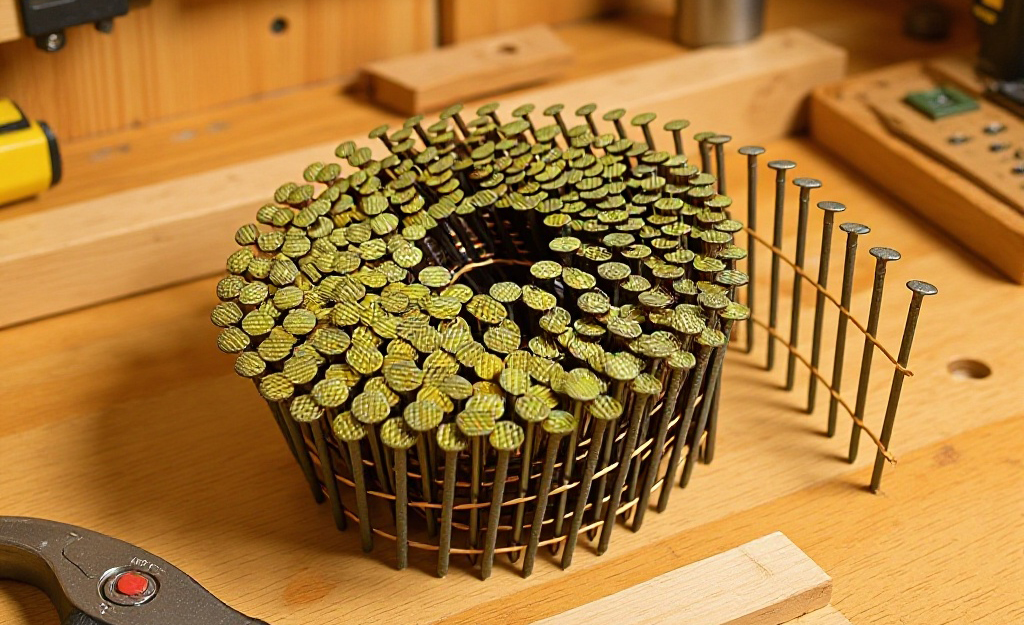
In the sophisticated system of modern industrial production and engineering construction, fasteners serve as the "structural link," whose performance directly determines operational efficiency, product durability, and safety factors. Coil nails—an efficient nail product composed of multiple equidistantly arranged high-carbon steel nails (surface treated with corrosion-resistant processes such as copper plating or galvanization) connected by high-strength copper-plated iron wire—have deeply penetrated core fields including construction, furniture manufacturing, and packaging. Thanks to their compatibility with pneumatic/electric coil nail guns for mechanized operations, strong holding power of 1500-3000N (exceeding ordinary round nails by more than 30%), and convenient "one-nail-through" usage, they have become an indispensable fastening "tool" across industries and a key driver for improving the efficiency of modern industrial production.
I. Construction Industry: Fortifying the Core Line of Structural Stability
The "dual requirements" of construction projects for fastening—long-term reliability and large-scale construction efficiency—have made coil nails an irreplaceable choice. In door and window installation, coil nails paired with professional pneumatic coil nail guns (firing rate up to 80-120 nails per minute) can quickly and tightly fix door and window frames made of broken-bridge aluminum, solid wood, and other materials to concrete or masonry wall bases. Compared to traditional manual hammering (only 10-15 nails per minute), the construction efficiency is increased by 6-8 times. Moreover, the evenly distributed fixing points ensure that the force deviation of the frame is controlled within ±5%, effectively avoiding loosening, deformation, air leakage, water seepage, and other issues caused by uneven force during long-term use of doors and windows. In ceiling engineering, the "precise penetration" of coil nails is particularly crucial for connecting light steel keels to ceiling bases such as gypsum boards and calcium silicate boards: their adaptability to specifications (nail diameter 2.8-3.2mm, length 16-50mm) enables firm engagement between keels and the base without damaging the board structure, ensuring that the flatness error of the ceiling does not exceed 3mm/2m and laying a solid foundation for subsequent decoration processes such as painting and wallpapering.
In outdoor construction components, specialized coil nails are a model of "environmental adaptability": 2 1/2-inch (approximately 63.5mm) coil siding nails are made of carburized high-carbon steel with a hardness of HRC45-50, which can firmly grip various exterior wall materials including wood, fiber cement, and metal carved panels. Even in harsh environments such as low temperatures of -30℃, high temperatures of 80℃, and humid conditions with annual precipitation exceeding 1500mm, they can maintain stable fastening performance for 5-8 years, with corrosion resistance 3 times higher than that of ordinary iron nails; ring-shank coil roofing nails, through a design of 3-5 continuous rings, increase the friction between the nail body and wood shingles/asphalt shingles by 60%, with a pull-out force of over 800N, effectively resisting the risk of detachment caused by extreme weather such as typhoons of magnitude 12, and building the first line of defense against water and wind for building exteriors and roofs.
II. Furniture Manufacturing Industry: The Key to Balancing Stability and Aesthetics in Assembly
The "durability" and "appearance" of furniture are often determined by the details of fasteners, and coil nails achieve a perfect balance of "functionality and aesthetics" in this field. In the assembly of cabinets, wardrobes, bed frames, and other cabinetry and frame-type furniture, the "differentiated selection" of coil nails meets the stress requirements of different components: smooth-shank coil nails (with a smooth surface without grooves) are suitable for splicing general panels such as MDF and particleboard, producing only half the wood fiber extrusion of threaded nails when driven in, which minimizes the risk of panel cracking while ensuring the connection strength reaches 1.2 times the industry standard; ring-shank coil nails (ring spacing 2-3mm) or threaded coil nails (thread pitch 1.5-2mm), with their special grooved design, significantly improve holding power, with pull-out force 80%-120% higher than that of smooth-shank coil nails. They are specifically used for high-stress load-bearing parts of furniture—such as the joints between bed legs and frames (needing to bear static loads above 300kg) and the corners of cabinet bodies (needing to resist the impact of frequent opening and closing)—ensuring that furniture does not easily loosen or wobble during a service life of more than 10 years.
At the same time, the mechanized operation characteristics of coil nails have completely solved the pain points of traditional manual nailing: through the precise positioning of automated production lines, the driving position error does not exceed ±1mm, and the depth of nail head embedding into the panel is controlled at 0.5-1mm, which not only avoids exposed nail heads affecting the appearance but also prevents panel damage caused by excessive embedding; compared to manual assembly, the qualified rate of furniture assembled with coil nails has increased from 85% to 99.5%, and the assembly efficiency has been improved by 3-5 times. The daily output of a single production line can be increased from 500 sets to more than 2000 sets, making coil nails the core fastener in large-scale furniture production lines and helping enterprises achieve standardized and efficient production.
III. Packaging Industry: Creating a Safe and Reliable Transportation Guarantee
In the logistics and transportation system, the "load-bearing capacity" of wooden packaging and pallets is directly related to the safety of goods, and coil nails play the role of "safety guardian" in this scenario. As the main packaging method for heavy goods (single box weight above 500kg) and precision equipment (such as machine tools and instruments), wooden packaging boxes need to have extremely strong compression resistance (bearing stacking pressure of 2000kg/m²) and impact resistance. Coil nails (common specifications: diameter 3.4-4.0mm, length 50-75mm) quickly splice the side panels, bottom panels, and cover panels of packaging boxes into an integrated structure through pneumatic coil nail guns. The shear strength at the splice reaches 1500N/cm, which can effectively prevent the packaging box from collapsing or deforming even under continuous vibration (acceleration ≤3g) and multi-layer stacking pressure during long-distance transportation, reducing the goods damage rate from 8% of traditional manual nailing boxes to less than 1%.
In logistics pallet assembly, the advantages of coil nails are even more prominent: standard 1200×1000mm pallets need to bear 1.5 tons of dynamic load and 3 tons of static load. Through the "multi-point symmetrical fixing" design, coil nails firmly lock the stringers, crossbeams, and decking of the pallet, controlling the deformation at the joints of each component within 0.3mm. The service life of the pallet has increased from 500 cycles of traditional manual assembly to more than 1500 cycles, the reuse rate has doubled, and the manufacturing cost of a single pallet has been reduced by 15%-20%. This saves a lot of packaging materials and replacement costs for logistics enterprises, while reducing wood resource waste, in line with the development trend of green logistics.
IV. Decoration and Renovation Industry: An Aesthetic Assistant for Improving Construction Efficiency
Interior and exterior decoration pursues the unity of "efficient construction" and "aesthetic presentation," and coil nails have become a "dual assistant for efficiency and appearance" in this scenario. In the installation of indoor decorative wall panels (such as solid wood wall panels and integrated wall panels), traditional manual nailing is not only time-consuming and labor-intensive (taking 2 hours to install per square meter) but also prone to uneven splicing gaps of wall panels (error ≥2mm) and exposed nail heads affecting the appearance. In contrast, coil nails paired with lightweight electric coil nail guns can shorten the installation time per square meter to 30 minutes. The nail heads are precisely embedded into the surface of the wall panels through "counterbore design," and after subsequent putty filling and sanding, the flatness error of the wall does not exceed 1mm, which does not affect the decorative effect at all. They are particularly suitable for scenarios with strict requirements on details such as high-end renovated residences and hotel guest rooms.
In addition, in the fixation of metal decorative parts (such as stainless steel decorative strips and iron hangings) and wooden decorative moldings (such as ceiling lines and skirting boards), coil nails, with their compact size (minimum specification: diameter 1.8mm, length 10mm) and strong penetration power, can achieve "invisible fastening" without damaging the surface coating or wood grain of the decorative components, avoiding the hole marks left by screw fixation. In large-area decoration scenarios such as shopping malls and office buildings, coil nails can shorten the overall construction cycle by 30%-40% while reducing labor costs, becoming an important tool for decoration companies to improve project profit margins.
V. Other Industries: Versatile Fasteners for Cross-Domain Empowerment
Beyond the three core fields, coil nails have achieved cross-domain empowerment in various niche scenarios with their "high adaptability" and "strong reliability." In the automotive manufacturing industry, coil nails are used for the precise fixation of automotive interior components—such as the connection between seat fabrics and polyurethane cushion bases, and the assembly of door trim panels (PVC material, fabric material). Their nail bodies are passivated to avoid scratching the interior materials, and the fastening force is uniform and stable, which can effectively prevent abnormal noises from interior parts due to vibration during vehicle operation (the abnormal noise rate has decreased from 12% of traditional buckle fixation to less than 2%), improving driving comfort.
In bamboo product manufacturing, coil nails are used for splicing and fixing bamboo furniture (such as bamboo sofas and bamboo beds) and woven bamboo crafts. The anti-corrosion coating on the nail body forms a good engagement with the natural fibers of bamboo, which not only retains the environmental texture and breathability of bamboo but also solves the pain points of bamboo being prone to cracking and loose connection, doubling the service life of bamboo products. In addition, in niche scenarios such as adobe wall sanding (traditional building restoration), temporary shed construction (construction site temporary facilities), and agricultural greenhouse frame fixation, coil nails meet the fastening needs of temporary or special scenarios through their convenient usage (no complex tools required) and reliable fastening effect, becoming a practical fastener that "plays a big role in small scenarios."
From the structural construction of high-rise buildings to the precision assembly of daily furniture, from the safe packaging of heavy goods to indoor and outdoor decoration, coil nails have become a cross-industry fastening "backbone" with their core advantages of "efficiency, stability, and convenience." With the continuous upgrading of industrial production technology, coil nails are developing towards the direction of "lightweight, high-strength, and multi-material"—new products such as carbon fiber coil nails and degradable bio-based coil nails have entered the R&D stage. Their application scenarios will continue to expand, not only meeting the requirements of harsher usage environments but also providing more solid fastening support for the high-quality development and green low-carbon transformation of various industries, becoming an indispensable "small but crucial" part of the modern industrial system.





 中文
中文