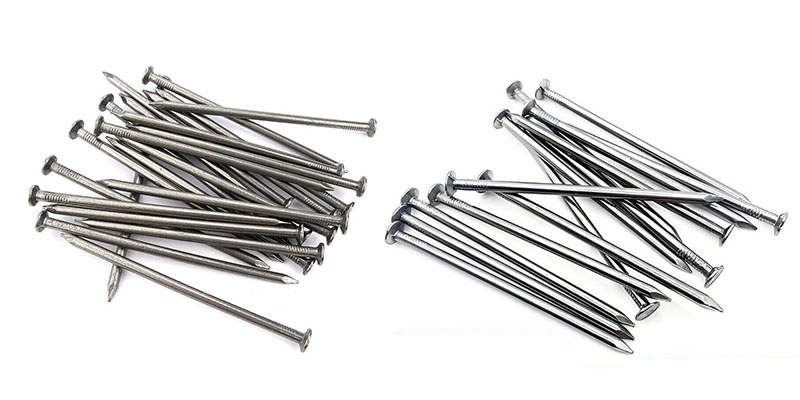




The differences between iron nails vs stainless steel nails and their application scenarios
Dimension
Iron Nails
Stainless Steel Nails
Material & Corrosion Resistance
Low/middle-carbon steel, no rust-resistant components; rusts in humid/outdoor environments within 1-3 months, easily staining wood and walls
Contains chromium (≥10.5%) and nickel (8%-10% in 304, 10%-14% in 316); 316 adds molybdenum. 304 resists general humidity; 316 resists salt spray/acids/alkalis
Strength & Service Life
Medium hardness (HB100-150); prone to deformation under long-term stress; outdoor service life of 1-2 years
Higher hardness (HB150-200); resistant to tension and shear. 304 has a service life of 5-10 years; 316 reaches 10-15 years
Cost
Low: Approximately 1/3 to 1/2 the cost of 304 stainless steel nails
High: 316 is 20%-40% more expensive than 304
Core Advantage
High cost-effectiveness, suitable for short-term, low-cost scenarios
Strong durability, adapted to long-term, high-demand scenarios
II. Scenario-Based Application Guide (Precise Demand Matching)